Our Alaska bird tour with Red Hill Birding was memorable on several levels. If you’re thinking of doing a similar trip, here are some things we learned along the way:
Fewer Lifers compared to other birding tours – We ended up with 21 Lifers, which wasn’t that many compared to other birding tours of similar length. The main reason for this was that many of the species we observed in Alaska we had previously seen migrating through the U.S. midwest. Participants from other parts of the country (where fewer birds migrate through) probably had more Lifers. Several of the Lifers we did see (like the Jaegers) just come inland to breed and then spend the rest of the year at sea. If you would like to view the complete list of species I saw CLICK HERE to see our eBird Trip Report.
Some species looked different – Many species change their plumage during breeding season so even though we have seen them during migration, they haven’t been in breeding plumage. Species like the Snow Bunting, Red Phalarope, and Long-tailed Duck looked so different I hardly recognized them – almost like seeing a different species.
The trip wasn’t only about Lifers – Where else can you go to see miles and miles of tundra, calving glaciers, moose, grizzlies, and muskox? Go birding at 11 PM? Go to a town that you can only travel to by air or water? Alaska, the final U.S. frontier is a huge, desolate land where millions of birds go each summer to breed.
Travel days reduced birding time – In order to bird Nome and Utqiagvik we had to fly. This meant being in airports and airplanes four days during the tour. Josh, our Red Hill Birding guide, made sure we birded before and/or after each flight (the day we flew to Utqiagvik we birded until 11 PM) but it still took a significant time away from birding.
The tundra was worth the trip – I never quite understood what “tundra” was but seeing it in full bloom in June, extending out as far as you could see, was impressive.
Not a trip for “foodies” – Once we got to Nome and Utqiagvik there weren’t many “fine dining” choices. In fact in Nome there were only three restaurants and the group voted on which one we wanted to go back to on our fourth night there. The food wasn’t bad – it wasn’t great either.
The group was split in Nome and Utqiagvik – Rental companies in these towns did not have vans large enough to accommodate our whole group so two vehicles were used. Even though Josh and Johnny (the other Red Hill Birding guide) had walkie-talkies, birds seen by the participants in one vehicle were not always seen by those in the other. This was frustrating at times, if you missed a bird others saw.
Bird Photography was challenging – Once up in Nome and Utqiagvik we were surrounded by tundra. The positive side of this was you could see birds from a great distance (because the tundra is relatively flat and goes on for miles). The downside is that birds could be a great distance away, making viewing and photography difficult. When birding in wooded areas your vision is limited by the trees, so there’s little chance of taking a Great Bird Pic from 100 yards away. On the tundra you can easily see 1 – 2 miles so it’s tempting to take pictures of birds at great distances. Also, being a flat surface it’s hard for the camera to focus on a bird out on the tundra. The combination of long-distance and manual focus photography made for fewer Great Bird Pics. Bring the biggest lens you have!
Bring warm clothing – even though it was late June, there were times when Karen and I felt cold. We know how to layer-up, and did so, but when the sun was covered, the wind was blowing, and fog covered the ground it was hard to keep the chill out.
Was it worth the trip? Yes! This was one of those “trips of a lifetime.” The Alaskan frontier is rarely visited but I found it had a stark beauty. Yes, we saw many species there that we’ve seen migrating through the midwest but some of them looked quite different in breeding plumage. The Lifers we had (i.e. Eiders, Jaegers) were definitely worth seeing.
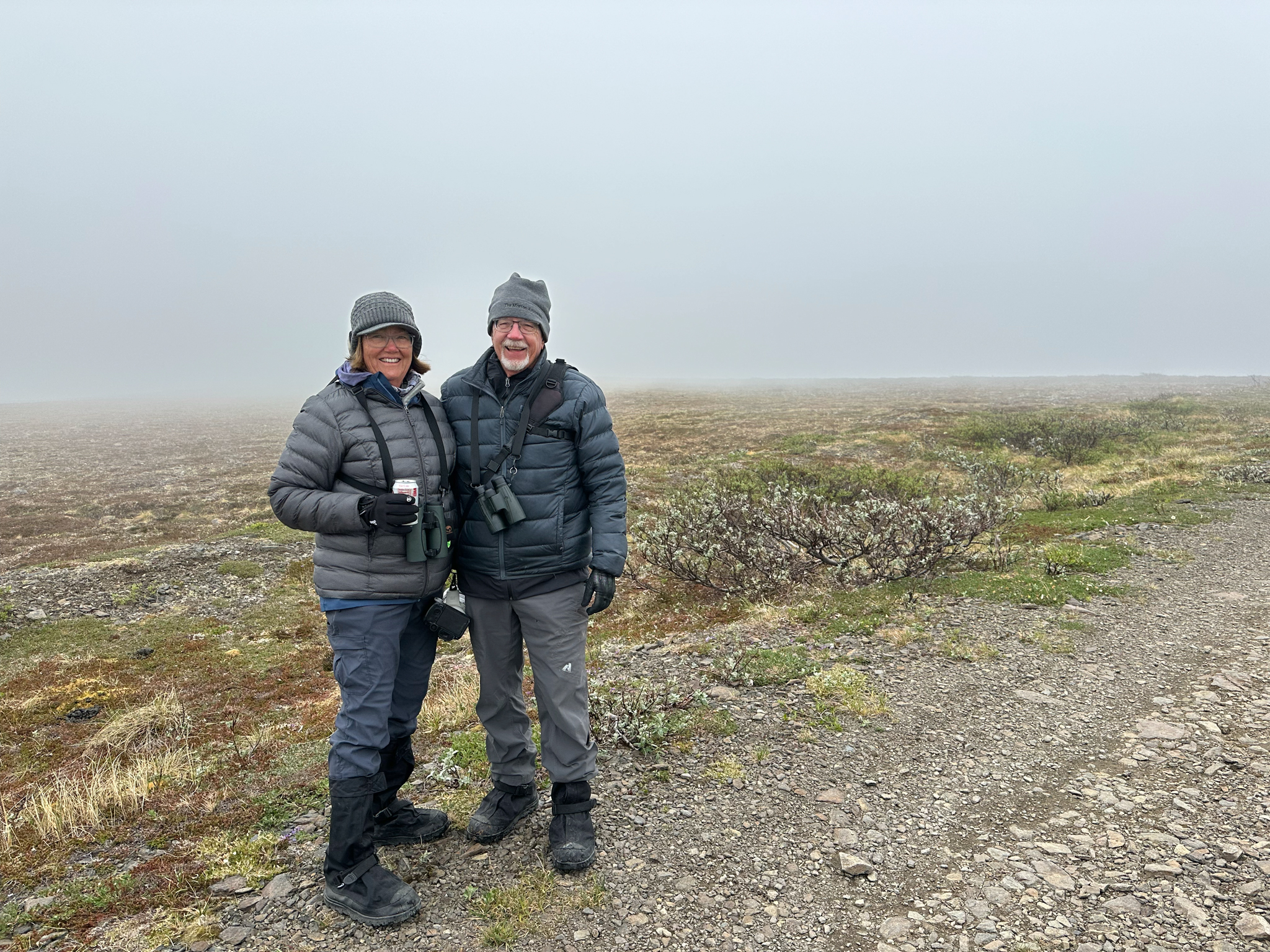
This is the final post about my Alaskan bird tour. It started in Anchorage, then went to Seward, Nome, and Utqiagtiv/Barrow. CLICK HERE to see all the posts about our Alaskan Bird Tour.
Karen and I have had the opportunity to travel to many interesting places in search of birds. If you would like read about some of our other Bird Tours CLICK HERE.
If you enjoy seeing beautiful pictures of birds from around the world and reading about them CLICK HERE to sign up for our mailing list. Members can post their own Great Bird Pics and learn more about bird photography techniques.