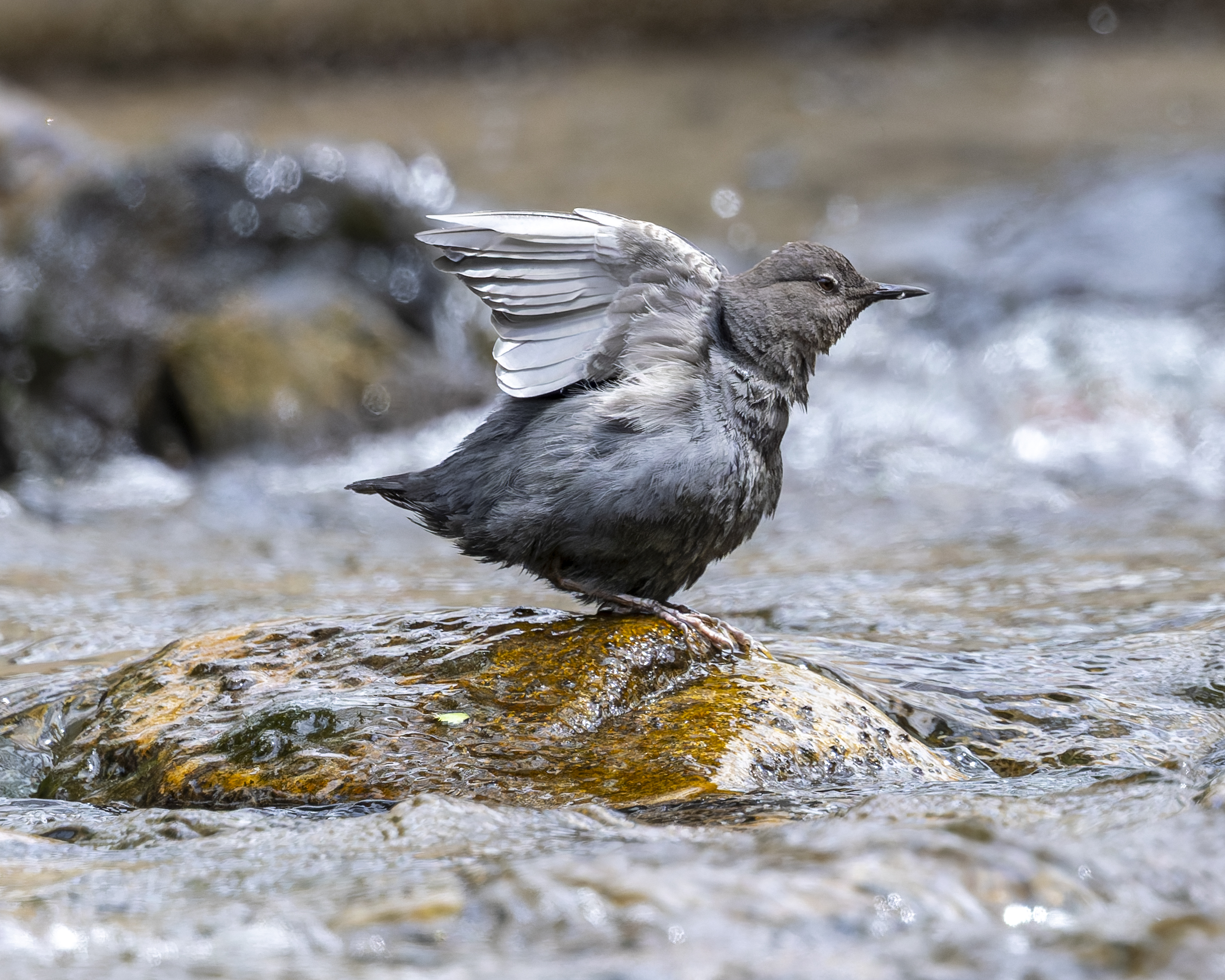

Massive Uropygial (Preen) Gland: Dippers possess a preen gland near the base of the tail that is roughly 10 to 12 times larger relative to body mass than that of any other songbird. They spread this oil across their feathers constantly, creating a hydrophobic outer barrier where water immediately beads and rolls off.
Extremely Dense Feather Count: Unlike most passerines, dippers have a much higher density of contour feathers with tightly interlocking microscopic barbules. This tight weave creates a physical shield that surface tension and water droplets cannot easily penetrate.
Thick Underdown and Air Trapping: Beneath the contour layer lies a dense bed of down feathers that traps a microscopic layer of air against the skin. This trapped air prevents freezing water from making contact with the bird’s body and provides natural buoyancy.
Instantaneous Water Shedding: Because the water sits strictly on the oily outer tips of the feathers rather than soaking into the feather shafts, a single quick body shimmy or wing flutter—like the motion captured here—casts off water droplets instantly, leaving the plumage looking completely dry and fluffy.
Vivian Park
Utah
- Created Timestamp05/05/2026 21:14:25
- CameraCanon EOS R5m2
- Aperture7.1
- CreditMichael Affinito
- Focal Length500
- Iso2000
- Shutter Speed1/2500
Congratulations – this Great Bird Pic is being featured as part of our Members’ Showcase on 10/29/26.
Great info and Dipper pic